Brokeback Mount Doom by Inmn Neruin
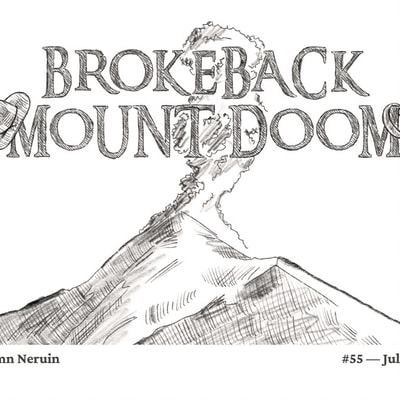
Transcript
Hello, I'm Cassandra, and this is Strangers in a Tangled Wilderness, a monthly podcast of anarch literature where we take our monthly zine, turn it into an audio feature, And then interview the author. We're looking for content that doesn't know where it fits in, for people that don't know where they fit in. You can get a copy of the monthly zine by signing up for our Patreon at patreon.com/strangersinatangledwilderness, or you can read along for free at tangledwilderness.org. For regular listeners, you might be wondering why I'm not Inman, and the answer is that this month's feature, which is titled Brokeback Mount Doom, is by Inman, which which means that they're still here, but we'll talk to them in just a little bit. Brokeback Mountain Doom was originally written and performed on stage at Shakespeare Theatre's 10 Minute Movies in 2026. It reimagines The Lord of the Rings and Brokeback Mountain mashed together in glorious harmony. We're extra lucky this month 'cause we get to listen to a radio-style recording of the production with the original cast, so that's super exciting. Then stick around afterward while I ask Inmin all of our burning questions about gay hobbits, and collaborative theater. But first, we're a proud member of the Channel Zero network of anarchist podcasts. Here's a jingle from another member of the network.
Speaker B:Hell, oh, this is an ad for The Spectacle. It's kind of a cultural analysis podcast, but also an anarchist podcast, but it's listed in the comedy section of Apple Podcasts, so everything we say counts as parody. Nice try, J. Edgar Hoover. It's for people who like low art and hate cops. Just a bunch of nasty freaks talking movies and shit, because it's a really grim time to be a radical. We just wanted to make something stupid. I'm on that Arm Joy shit. If I can't do bits, it's not my revolution. It's fun! So come on by every so often and listen to The Spectacle, the only podcast that— it's the, it's the only podcast. There's none left. There's none left. There was an accident, and this is the only one now. The Spectacle, from Strangers in a Tangled Wilderness, On Channel Zero.
Speaker C:Brokeback Mount Doom by Inman Narowin and the cast of Brokeback Mount Doom. Published by Strangers in a Tangled Wilderness. Performed by the original cast of Brokeback Mount Doom with Dominique as Frodo, Inman as Sam, Blix as Gollum. Sam as Gandalf.
Speaker A:Merry as Rosie.
Speaker C:Brokeback Mount Doom was originally written and performed for the stage for Shakespeare Theatre's 10 Minute Movies 2026, and reimagines The Lord of the Rings and Brokeback Mountain mashed together in glorious harmony. Whenever there is a tender or sad moment, imagine Wings from the Brokeback Mountain soundtrack playing, or that at the end Frodo plays the Shire Theme on a flute. At the end of all things. The set and props are entirely painted cardboard. Shakesqueer earnestly hopes that you adapt and perform Brokeback Mount Doom for your community, who laughs, cries, and loves as you venture into the heart of the mountain. Challenge them to kiss someone every time someone says Brokeback Mount Doom. Find a video of the performance on YouTube by searching 10 Minute Movies Brokeback Mount Doom. There's a lot more raunchy shit that didn't end up in the radio play. Act 1: Shadow of the Past. The Shire, midday. Gandalf enters half-dragging Frodo. Sam enters unseen and hides behind a bush. The Eye looms in the sky.
Speaker F:Come, Frodo, it's time for your birthday gift. The world is changed. I feel it in the earth. It began with the forging of the Great Rings. 3 were given to the Elves, 7 to the Dwarf-lords, and 9 Rings were gifted to the Men, who above all else desire power. But they were all of them deceived, for in the fires of Brokeback Mount Doom the Dark Lord forged the One Ring. And into this Ring he poured out not only his will, but an ungovernable strangeness that tempts all who come near to it. Many resisted the Ring, and on the slopes of Brok-brok Mount Doom they fought and defeated the Dark Lord. But the temptation of the Ring could not be undone, for Men are weak. I led Isildur into the heart of Brok-brok Back Mount Doom, the one place the Ring could be destroyed. But it wasn't, for Isildur kept it, and some things that should not have been forgotten were lost. The Ring passed out of all knowledge until it came to the creature Gollum. The creature that your uncle Bilbo totally stole the Ring from. And now, with Bilbo's passing, the Ring comes to you. And you, Frodo, must go to Brokeback Mount Doom and destroy the Ring, lest it bring ruin and temptation back to the hearts of men.
Speaker C:Gandalf takes an envelope out of his pocket and holds it out to Frodo.
Speaker G:Holy shit. But Gandalf, why wouldn't Bilbo destroy it?
Speaker F:Your uncle said that it made him feel precious. But the Dark Lord has returned. and set his sight on the Shire. Do you want him to come here?
Speaker C:Gandalf points to the quivering eye.
Speaker G:Of course not! But Gandalf, should we not take it to a king?
Speaker F:Fuck kings, Frodo! They don't care about you. Do you want to see the Shire burn?
Speaker G:N-no!
Speaker F:Then grow a pair and get thee to Bok— Back Mount Doom!
Speaker C:Gandalf throws the envelope at Frodo, who fumbles with it before removing the ring.
Speaker G:Uh, perhaps I can take it to Mordor. But must I go alone?
Speaker F:Alone you must go, for the ring will tempt the hearts of all those around you.
Speaker G:You're strong, Gandalf. You could take it and withstand it, I bet.
Speaker C:Gandalf becomes agitated and shakes Frodo as he talks.
Speaker F:No, do not tempt me, Frodo! For then in place of a Dark Lord you would have a dark grey Queen, not cruel, but beautiful and terrible as the dawn.
Speaker C:Gandalf throws Frodo to the ground as he recovers from agitation. Sam springs from the bushes to help Frodo up. Well, he might be going alone, but I'm coming with him.
Speaker F:Confound it all, Sam!
Speaker C:Rosie enters, polishing a beer mug.
Speaker G:What about Rosie, Sam? You were only just married.
Speaker C:She'll understand. It's important work, it is. Rosie furrows her brow in disagreement.
Speaker F:Fine. But make sure that when you rest at night that you do so well apart, for the ring does strange things to fools' hearts. And do not put the ring on For it will make things that once seem strange not out of place, and who knows what could happen in that state?
Speaker C:Sam raises his hand to ask a question, but Gandalf smacks Sam's hand with his pipe.
Speaker F:No more questions! Fly, you fools, to the heart of Barad-dûr!
Speaker C:Sam and Frodo clasp hands and set out walking towards the Eye, which retreats as they approach. Lights down. Act 2: The Ring Tempts Frodo. Along the road, midday. The Eye looms in the sky. 2 Ringwraiths enter and lie in wait as Sam and Frodo enter. Sam wields a frying pan. The Ringwraiths descend on the hobbits, separating Sam and Frodo. One of the Ringwraiths stabs Frodo. Sam fights his way to Frodo, bludgeoning the wraiths away. Sam and Frodo exit hurriedly. The Ringwraiths exit opposite. Sam and Frodo reemerge out of breath. I sure don't like the look of those riders we saw earlier, Mr. Frodo. They were a menace, they were.
Speaker G:Yes, they— they called to me as we ran. Put it on, they said. Join us, they cried.
Speaker C:Frodo trembles and inches the ring towards his finger. Sam puts a hand over Frodo's finger and Frodo calms down.
Speaker G:Don't let it trouble you, Sam.
Speaker C:Don't let it trouble me? They stuck your arm full of wicked steel, they did. Now you just lie here and get some rest. Sam sets up a tent and sits Frodo in it. Sam then goes to sit against a rock nearby.
Speaker G:Sam, come in the tent. You'll freeze out there.
Speaker C:But we must do as Gandalf said. The Eye of Mordor ain't findin' us on my watch, Mr. Frodo.
Speaker G:But Sam—
Speaker C:Frodo settles in the tent. Sam shivers outside.
Speaker F:Oh no.
Speaker G:The Eye is upon me. Oh, I feel it piercing earth, sky, and flesh. Oh, and why shouldn't I put this on? The ring did come to me.
Speaker C:Frodo trembles and shoves the ring on his finger.
Speaker G:Oh, I've never felt so precious.
Speaker C:Oohhh! Sam shivers intensely as the wind blows.
Speaker G:Sam, quit your yammering and get in here before you catch your death!
Speaker C:Sam reluctantly climbs into the tent and looks down to the ring on Frodo's finger. Mr. Frodo, have you abandoned reason for madness?
Speaker G:Madness? Is it madness to feel this... Precious!
Speaker C:Get it off! Sam grabs Frodo's hand and they wrestle for a moment. Oh stars, now it's tempting me! Sam and Frodo wrestle tensely before freezing, looking into each other's eyes and kissing. They both fall to the ground in a passionate flurry before settling and falling asleep. Gollum enters unseen.
Speaker D:Finally we've found our precious.
Speaker C:Lights down. Act 3: Riddles in the Dark. The encircling mountains, midday. The Eye looms in the sky. Sam and Frodo enter, holding hands. The mountains shift around them, the sun and moon rising and falling as they walk. We're going in circles, we are. I don't think Gandalf meant for us to come this way.
Speaker G:Gandalf didn't mean for a lot of things to happen, Sam. But they did.
Speaker C:But we've got to escape this maze of loneliness and madness.
Speaker G:Is it so bad, Sam? We've got each other.
Speaker C:But by rights we shouldn't even be here.
Speaker G:But we are here. Would it be so bad for us to linger a while? This is a real one-shot thing we got going here, Sam. When the Ring is gone, what will become of us? At least here, what happens here, It's no one's business but our own.
Speaker C:Frodo embraces Sam. Gollum enters unseen and hides. Sam lingers in Frodo's arms for a moment before breaking away. It's only a passin' thing, this queer shadow.
Speaker G:For those who have seen this queer shadow, can they ever really go back, Sam?
Speaker C:I suppose, if they had something they were holding on to.
Speaker G:And what are we holding on to, Sam?
Speaker C:Gollum springs out of hiding.
Speaker D:Stupid hobbits do not see what lies ahead when sun has faded and moon is dead. We might know the way you seek, not like stupid hobbits sad and weak.
Speaker G:You're Gollum, aren't you? Or is it Smeagol? You too once carried the Ring.
Speaker D:Gollum! Gollum!
Speaker F:We did.
Speaker D:For 200 years deep underground it drove us, where we soon forgot the taste of bread and the sound of trees. It was all we were, all we could see and feel, till a stupid hobbit stole our preciousness from us.
Speaker C:I don't like the look of this stinker, but perhaps he could lead us out of this place, Mr. Frodo.
Speaker G:Smeagol, would you like to serve the Precious again?
Speaker D:We could. We swears to serve the master of the Precious.
Speaker G:And the Precious will hold you to that promise.
Speaker C:Sam reaches out for Frodo's hand, but Gollum grabs it first and pulls Frodo ahead. Sam sighs and follows. The 3 walk through the shifting mountains as the sun and moon rise and fall.
Speaker E:Gollum twirls Frodo as if dancing.
Speaker C:But Frodo stumbles and falls, gasping. Sam rushes to help Frodo, but Gollum jumps in his way and gets to Frodo first. Sam sits down separately and takes a potato out of his pocket, which he starts to eat.
Speaker D:Is master okay? We know the weight you hold. Stupid hobbit will never understand.
Speaker E:But—
Speaker G:Sam is sweet.
Speaker D:Yet a day will come when he will grow jealous and he will try to take your preciousness from you.
Speaker C:Sam approaches Frodo and Gollum. What are you sneaking about?
Speaker D:Stupid hobbit is always so nice to us, but now Gollum will be good to master, yes. We will go fetch us a real treat, not like stupid taters.
Speaker C:Gollum skulks away to the stream. We've got to get rid of this stinker. He's leading us in circles.
Speaker G:Why do you do that? Call him names and run him down like that?
Speaker C:He's a villain, he is. Gollum snatches a fish out of the stream.
Speaker D:Rock and pearl is now some curl, so juicy sweet.
Speaker G:You have no idea what the ring did to him. What it's still doing to him.
Speaker D:Our only wish to catch a fish so juicy sweet.
Speaker C:I care about what the ring is doing to you, Mr. Frodo.
Speaker G:And will you hate me as well when I become like him?
Speaker C:Sam rests a comforting hand on Frodo's shoulder. You won't, sir.
Speaker F:You won't.
Speaker C:But if it's weighing on you, maybe I could help carry it for a while. Share the load.
Speaker G:Get away, Sam!
Speaker C:Frodo recoils from Sam as Gollum rushes back to the hobbits with the fish.
Speaker A:See? See?
Speaker D:He wants it for himself.
Speaker G:Shut up!
Speaker C:I only want to help you, Mr. Frodo.
Speaker G:You can't help me anymore, Sam. Why don't you just— let me be?
Speaker F:I wish—
Speaker C:I wish I knew how to quit you, Mr. Frodo. Especially when you get like this. But I can't. I can't.
Speaker G:Go home, Sam.
Speaker C:Sam reaches out to comfort Frodo, who recoils and turns away from Sam. Gollum chuckles silently as Sam exits.
Speaker D:Haha, look, look at the tasty fish I got us, master. Stupid hobbit would ruin it over the fire. We like ours raw and wrigglin'.
Speaker C:The lights go down on Gollum eating a fish. Act 4: The Choices of Master Samwise. The stage is set for 2 scenes. The Shire at midday is on one side, and the encircling mountains on the other. The Eye looms in the sky. Rosie cradles a baby in the Shire. Sam enters, wiping a tear from his eye.
Speaker A:Sam!
Speaker E:Got rid of that nasty ring, I bet.
Speaker C:Rosie hands the baby to Sam, who looks amazed. We did, Rosie. We saved the Shire and all of that, I suppose.
Speaker D:Where's Mr. Frodo?
Speaker E:Did y'all have a falling out?
Speaker C:We had a disagreement. Over fish.
Speaker D:Well, I'm sure you two will fix it. You always do.
Speaker C:Aye, and if you can't fix it, you've got to stand it. But for how long? Sam and Rosie exit. Frodo and Gollum enter the encircling mountains, dancing. Gollum spins Frodo, who stumbles and tries to catch his breath.
Speaker A:Ooh!
Speaker D:Is master alright?
Speaker G:I feel the gaze of the Eye upon me ever more fiercely. Perhaps Sam was right. Maybe we should finally be rid of it.
Speaker D:It is a heavy burden. Stupid hobbit couldn't know, but we know. We will lead you where you seek.
Speaker C:Frodo lays his head in his hands and closes his eyes, falling asleep. Gollum wanders off.
Speaker D:Be rid of it? More like destroy it! But master said that we would always serve the precious. How can we serve the Precious if the Precious is destroyed? Master broke his promise? Betrayed us! We ought to kill Master! Yes, yes! Then we would be master of the Precious!
Speaker C:Gollum shakes Frodo awake.
Speaker D:This way, Master.
Speaker C:Gollum and Frodo exit. Sam enters the Shire, packing a bag. Gandalf and Rosie, with her baby in hand, follow closely behind Sam. The Eye still looms overhead.
Speaker F:But why on earth would you want to go back out to Brokeback Mount Doom?
Speaker C:Just to check on things, if you will.
Speaker E:You've got responsibilities here now, Sam.
Speaker D:Don't you think you spent enough time out there with Mr.
Speaker E:Frodo?
Speaker C:I've just got to clear my head. Maybe Mr. Frodo and I could go fishing again. We caught some mighty good trout out near the Cracks of Doom.
Speaker F:You know that I am a wizard, Sam, and that I can see many things without seeing. And I know what you two got up to on the slopes of Brokeback Mount Doom. And boy, did you two find a way to pass the time.
Speaker C:You saw everything, Sam.
Speaker F:Ohhhhh.
Speaker G:I did always wonder why it took you so long to destroy such a tiny thing.
Speaker F:Well, they didn't destroy it! They just fucked around for a whole year!
Speaker E:Frodo a Bag End? More like Frodo a nasty end!
Speaker C:I should have never left, Mr. Frodo. And Gandalf, you don't know shit! Sam kicks Gandalf and runs off, exiting. Lights down. Act 5: The Ring is Destroyed. Brokeback Mount Doom, evening. The Eye looms in the sky. Gollum enters, followed by Frodo, who is struggling.
Speaker D:All's well, master.
Speaker G:I wish the ring had never come to me.
Speaker D:So do all who live to see such things, but it will be over soon.
Speaker E:Gollum points Frodo ahead.
Speaker C:As Frodo passes, Gollum picks up a large rock.
Speaker G:Smeagol, I don't see the Crack of Doom.
Speaker C:Frodo turns to see Gollum standing over him, rock raised.
Speaker G:Smeagol, what are you doing?
Speaker E:You swore to serve the Precious!
Speaker D:He lied! We could have had a good life together, a real good life. We could have had a place of our own, a cave somewhere deep, plenty of fish. Some good mud! But no, you didn't want that. Now Master is lost and can never go home, and he will weep to be so alone.
Speaker C:As Gollum raises the rock to crush Frodo, Sam enters wielding a frying pan. He might be alone, but he's got me! Sam bludgeons Gollum with his frying pan. Gollum screeches, exiting. Sam rushes to help Frodo up.
Speaker G:Sam! I'm too weak to carry on.
Speaker C:I may not be able to carry the ring for you, Mr. Frodo, but I can carry you! Sam slings Frodo across his back. The two stumble along before Frodo slips. Sam catches Frodo, readjusts, and cradles Frodo in his arms. Do you remember the Shire, Mr. Frodo? It'll be spring soon, and they'll be eatin' strawberries and cream. Do you remember strawberries?
Speaker G:No, Sam. I can't recall the taste of food at all. Nor the sound of water. I'm naked in the dark before a lidless eye.
Speaker C:But do you at least remember when you asked me what I was holdin' on for?
Speaker G:I do. I think I was holding out for a dream of us together, hidden away on Brokeback Mount Doom, a place where no good thing can thrive. And after I pushed you away, there were— there were nights where I missed you so much I could hardly stand.
Speaker C:Well, if you can't stand it, you've got to fix it.
Speaker G:But for how long?
Speaker C:For as long as we can ride it. There ain't no reins on this one, Mr. Frodo.
Speaker G:Those words come easy now. But how can we ever have a happy ending when we're sitting here at the end of all things?
Speaker C:I imagine that's what all who are faced with such times say. But that's the way of tales sometimes, ain't it? Real tales, at least. The tales that really matter. Where those in 'em don't know what they're wandering into, just that they have to keep going. And not always to a good end, mind you. At least not what folk would call a good end, where they come home and find things all well and that nothing's changed. I don't think that's the kind of story we're in, Mr. Frodo, because I've changed. And I'm not sure I want to go back straight to how things were, at least not exactly. And as for us, I can't say how we'll end. Just like the people in those tales don't know whether they'll get a happy ending or a sad ending. There are no promises. And that's why those tales matter. Because they're real.
Speaker E:Like we're real.
Speaker C:Sam leans in and kisses Frodo.
Speaker G:Oh Sam, let's be rid of this thing.
Speaker C:Sam and Frodo rise and limp off together. Exiting. The lights dim and a red glow appears at the edge of the stage, shining upwards. The Crack of Doom. Sam and Frodo re-enter and limp towards the crack. Are you ready, Mr. Frodo?
Speaker G:I am, Sam.
Speaker C:Frodo struggles to raise the ring.
Speaker G:Sam, I, I can't do this alone.
Speaker C:Frodo places Sam's hand on his. Do you mean it, Mr. Frodo?
Speaker G:I do, Sam.
Speaker C:Frodo leans in and kisses Sam. Gollum enters.
Speaker D:Filthy hobbits! We want our precious!
Speaker C:Gollum jumps on Frodo. They all wrestle with the ring for a moment. Sam and Frodo look into each other's eyes and let go of the ring. Gollum falls into the red glow clutching the ring. The eye falls to the ground. The earth shakes. And the red glow dies. Let's get you home, Mr. Frodo. Frodo settles into Sam's arms and takes out a flute and plays a familiar theme. Lights down. Act 6: The Breaking of the Fellowship. The Shire. Midday. Rosie cradles her baby while Gandalf smokes his pipe. Sam and Frodo enter arm in arm. Sam exchanges a smile and a wave with Rosie before exiting.
Speaker E:Tell me again why the Eagles couldn't have taken the ring?
Speaker F:Oh, it simply wasn't possible. They said no.
Speaker C:Gandalf and Rosie exit. Frodo enters alone and places a shirt and a letter on the ground before stepping side stage and out of the room. Sam enters alone. What's this letter from my Mr. Frodo? He said he'd just gone out for the day to get some longbottom leaf. Sam opens the letter and reads it.
Speaker G:Dear Sam, we may have set out to save the Shire, and we did, but not for me. These last few months with you have been more than I could ever hope for, but it can't be like this always. There are some things Time just can't mend. And I know you could never leave the Shire, but I can't always be torn in two. And the Shire just doesn't fit me anymore. I need something more, something bigger. I've got to be one and whole now, at least for a while. But I thank you for showing me that we can have more than Brokeback Mount Doom. Keep our tale going, Sam. People need to Here of Samwise the Brave. I wouldn't have gotten very far without him. This might not be the ending we hoped for, but it was happier than I could have ever imagined.
Speaker C:Sam touches the shirt to his face and begins to cry. Lights down. The end.
Speaker A:All right. Welcome, Inman, to the show that you usually host. Do you want to introduce yourself?
Speaker E:Yeah. Wow. The tables have turned quite literally. I'm Inman Nerwin. I use they/them pronouns, and I do a lot of stuff here at Strangers. I usually am the one interviewing people, and I also write plays with a group called Shakespeare Theater. Wow, this is actually hard. Why do I put people through this?
Speaker A:Introducing themselves.
Speaker E:Introducing themselves. I also write games, and I helped write the Penumbra City game put out by Strangers in a Tangled Wilderness, and a forthcoming game called Curse of the Maw King based on the comic by Forest Storz, and it's going to be very silly and fun. And I'm excited for everyone to play it.
Speaker A:And also a forthcoming play.
Speaker E:Oh, yeah, that's more relevant. Well, we already did the play. We performed it in Tucson like almost 2 years ago at this point, a year and a half ago. And that's a play called Only Fools. And Strangers is gonna publish a book version of it, which I'm really excited about, and I'm totally definitely working On the manuscript right now, even as we speak.
Speaker A:I will peer pressure you because I get to do the book design and I really like designing plates.
Speaker E:So look forward to that. Yeah, it's gonna be silly. It's about—
Speaker C:it's got—
Speaker E:it's about 2 time-traveling anarchists who go back in time to kill King James and stop capitalism from ever happening, but they get wrapped up in the plot of Hamlet along the way.
Speaker A:It's delightful. What is Shakespeare, since we're talking about your plays?
Speaker E:God, why do I do this to people? This is cruel.
Speaker A:You can do it. The people want to know.
Speaker E:Shakespeare Theater is a collaboratively run theater troupe in Tucson, Arizona, and I've completely outed where I live if anyone's been wondering this whole time. The context clues were there. And we put out a play every spring. It started as just some friends at a party who like wanted to put on a play together. They just had this like harebrained idea, you know, like, let's put on a play. I wasn't part of it then, but they put on Twelfth Night.
Speaker B:Cool.
Speaker E:And I don't think they were explicitly like a queer theater troupe even at the time. They were just doing this one-off thing. And everyone just loved it. I loved it. I happened to be visiting when the performance happened, and I was like, I love this. This is beautiful. I want to do this. And then next year—
Speaker A:This is before you lived there?
Speaker E:Well, it's in between living there. I lived in Tucson, and then I moved to live on a land project. Then I ended up moving back sort of accidentally during COVID Check. Yeah, but I just happened to be visiting And they put out auditions for Macbeth. We're not in a theater, I can say it. And I was like, I'm gonna extend my trip by like 2 and a half months to do this play.
Speaker F:Wow.
Speaker A:Oh, that's fun.
Speaker E:And then I was hooked.
Speaker A:Yeah.
Speaker E:Yeah.
Speaker A:What's collaborative theater?
Speaker E:Collaborative theater is, I feel like, this thing that we've been trying to do a lot for folks who work in traditional theater, It's very similar, except— but except for one person telling you what to do and having final say over everything, we actually all figure out what to do and work on it together. And we get to say things like, no, I don't want to do that, and, what if we did this other thing?
Speaker A:Mm-hmm.
Speaker E:So it's just doing it collaboratively and kind of trying to break down some of the traditional hierarchies that exist in theater. We have a director. The director is not in charge at Shakespeare. The director's job is— which I will say for a while at least was rotating, and then I kind of was directing a lot of the shows because no one wanted to, and I love an administrative task.
Speaker A:So they're more of an administrator and wrangler of people.
Speaker E:An administrator and a wrangler of people. And to sum it up, it's like a We would kind of co-envision a play, and then usually sometimes a group of people would rewrite it, sometimes one person would rewrite it, or working on the script or the vision. But the director's job for Shakespeare is really just to have ideas about how to put it on the stage.
Speaker A:Oh, that's fun.
Speaker E:And to sit there and hold the vision of it. And yeah, that's kind of their role, which, like, more normally in theater, it's like, I don't know, directors very stereotypically can be these, like, tyrannical little, like, overlords who are like, no, I want you to do this thing. And an actor might be like, I don't want to do that. I don't like that. And the director's like, well, do that.
Speaker A:But it's my vision.
Speaker E:Yeah.
Speaker A:Sure.
Speaker G:Okay.
Speaker E:I famously have had a lot of really harebrained ideas in the troupe. And through consensus have been voted down— isn't the right word because it's consensus— but everyone's like, we don't want to do that. And I'm like, okay, cool, let's figure something else out. What do y'all want to do?
Speaker A:Yeah. So is collaborative theater, is that a thing that exists outside of Shakespeare?
Speaker E:I'm sure it does. Or is this a thing that y'all coined? I don't think we coined it by any means. And it's not necessarily like how we talk. We're not like Shakespeare Theater, a collaborative blah blah blah. It's like, because we're all punks, we're all anarchistic. The root of the project is very anarchistic. We're just bringing those ideals into the thing that we're doing.
Speaker B:Yeah.
Speaker E:Like, in the same way that we would do it for anything, like starting like, a book club or a publishing collective or whatever. We're just applying our life ideals to the art medium that we're doing.
Speaker A:Yeah, that makes sense. We talk about outside of theater in life in general, when we're talking about applying anarchist principles, there are all these benefits to operating outside of authority and hierarchy. And I guess I'm curious, because you've worked in traditional theater, and collaborative theater, what the creative differences are.
Speaker E:Yeah, well, it's like the creative differences are that everyone gets to be involved in the creative process. For instance, in some more traditional theater frameworks, an actor, if they're not part of the workshopping process— like a Broadway show, for example— if you're part of the If you're part of like the original cast that's like workshopping the play, you might have creative input into what your character does. You might.
Speaker A:Oh, interesting.
Speaker E:Yeah. Like, I know someone whose dad was the original Scar in The Lion King.
Speaker A:Wow.
Speaker E:Yeah, yeah, yeah.
Speaker G:Wow.
Speaker E:Yeah, it's wacky. And he got to develop a lot of the original like choreography and mannerisms of Scar.
Speaker C:And now that is completely frozen.
Speaker A:Huh.
Speaker E:Anyone who plays Scar from now on has pretty much no creative input. They're just doing choreography that was established like 30 years ago or whatever.
Speaker A:Okay.
Speaker E:And similarly, it's like if a— say a writer writes a play, they're not the director, someone else is directing it. The director is supposed to stay true to that vision. Sometimes things will change, But then like an actor, if there's like, say an actor is like, I want to say this line differently, and then they say the line differently, they could get sued for saying the line differently.
Speaker A:Really?
Speaker D:Yeah.
Speaker A:Wow.
Speaker E:Yeah.
Speaker A:No improvisation.
Speaker E:No, no improvisation. And like, yeah, I don't know. It depends on the director. It depends on the creative process. But it's like a lot of these big theater companies are owned and run by corporations now.
Speaker A:Sure.
Speaker E:So it's not like— and I don't know, that's like big theater. I'm sure it's different in a lot of community theaters, but it's like the creative differences are that we all get to be involved in the creative process and we're all invited into the creative process, which plays out exactly how it plays out in a lot of anarchistic things sometimes, which is like I remember having these creative meetings, forcing people to go to these creative meetings and being like, no, we're gonna co-create the theme for the play. And everyone else is like, Inman, we just want you to tell us what to do. And I'm like, no.
Speaker A:No. You're gonna have an opinion. It's amazing how much of anarchism is trying to convince people to participate. In order to do anarchism, you have to Yeah, yeah.
Speaker E:Which we've had like— there's just structural and time stuff where it's like, for Shakespeare, most of the time the actors are also the stagehands, are also the people making everything. I was wondering about that. Like, our front of house and back of house are so broken down that they're the same thing. In a way that's beautiful and also is really hard and it's really time-consuming.
Speaker A:Is it? I've never participated in theater. The closest thing I can imagine is working in a kitchen and the division between front of house and back of house and some of the animosities that grow and how people get paid and it's like class issues and it's a whole thing. And I'm wondering if front of house and back of house in theater is as fraught.
Speaker E:Yeah, I think it can be. It's like, and front of house, back of house is maybe not the right terms, like onstage, backstage.
Speaker G:Sure.
Speaker E:But like, I work in traditional theater as a stagehand, and like, I get paid pretty well, which I like, but it's because of a union.
Speaker C:Cool.
Speaker E:But we have different unions. Like IATSE is the stagehand union, and Equity is the actors union. We have different unions and they don't really work in tandem.
Speaker A:So is it hard for people to do both? Do people traverse both of those worlds?
Speaker C:In traditional theater, not really.
Speaker A:Okay.
Speaker E:Yeah. But it's like the way we do it is everyone's kind of everything, you know?
Speaker A:Sure, yeah.
Speaker E:And it's beautiful, but it also really gets in the way sometimes where it's like, we're like, okay, we're behind on production and we need to go have this painting day. And so we're like getting all the cast to come and like paint the set. And but some of the actors are like, wait, but I was going to be running lines with so-and-so and now I can't do that. And now I feel behind on that. And I'm like, yeah, it's a mess.
Speaker A:Yeah, yeah, that's hard.
Speaker E:Yeah.
Speaker A:I feel like it's that we sort of do that in Strangers in a Tangled Wilderness. publishing group that is putting on this podcast, where all of us wear lots of different hats depending on the projects and sort of run into time issues around that. But it's also nice 'cause we get to engage with lots of different interests.
Speaker E:Yeah.
Speaker A:Understand one another's roles.
Speaker E:Yeah, it's like you get to really understand what it takes to do something. like this. And I like to think everyone being involved a little bit in everything makes people more invested in it, and that we're not siloing out labor or whatever.
Speaker A:Yeah, like encouraging people to be stakeholders.
Speaker E:Yeah.
Speaker A:Yeah.
Speaker E:Yeah. In more than just the thing that they directly want to be doing.
Speaker A:Mm-hmm.
Speaker E:Which I say this and I'm like, this is not really by design. It's more out of circumstance. Like, I'm like, if we had a group of people who were like, yeah, I just want to like build everything, I'd be like, great. Which we do. Like, we have like a carpenter who's like mostly just doing the carpentry. Yeah.
Speaker A:Like, yeah.
Speaker E:Or like the lights and stuff is not on stage. Or like we have people who are like, I want to build this thing. And they're not like an actor or something. And we have actors who are like, no, I don't really have time.
Speaker A:I'm bad at painting and building.
Speaker E:Yeah.
Speaker A:That's fair.
Speaker E:Like, we approach it as equitably as we can. We're not like, like, you're involved, you have to create, paint like 10 backdrops or whatever, you know?
Speaker A:Mm-hmm. Yeah. I don't know why this keeps making me think of kitchens, where that's the points of contact I have in my brain. But I got to work. It was a total hippie kitchen and dysfunctional in some ways. But I worked in this particular kitchen where there was not a sous, there wasn't a chef or a designated dishwasher or anything like that. We were required to rotate roles.
Speaker E:Mm-hmm.
Speaker A:And I've never seen cooks rinse their dishes. I've never worked in another kitchen where cooks rinse their dishes, and it's because they had to wash dishes sometimes.
Speaker E:Yeah.
Speaker A:And similarly, I think there's a hierarchy that can establish itself in kitchens, but if the chef for a particular meal is the prep cook for the next meal, I don't know, it develops some appreciation, tempers egos a bit.
Speaker E:Yeah.
Speaker A:And I learned so much. about roles that I wouldn't usually fill, you know?
Speaker E:Totally. Like, you appreciate the stage more when you have to help build it.
Speaker A:Sure. Heck yeah.
Speaker E:I don't know. That makes sense. It also, like, it's like through this collaborative process, it's like, in which we try to really root out as many hierarchies as we can. We do the best job that we can, and sometimes we mess up.
Speaker C:Yeah.
Speaker E:But like, We get to experience like a huge level of like vulnerability and like trust with each other. And like, I don't know, this is convenient for me to say because I'm also like a forever Dungeon Master.
Speaker C:Uh-huh.
Speaker E:And I've sort of become like a forever director with Shakespeare, which I've like co-directed with people. And we just did this different event where like we had like 7 different directors because it was like a cover band show style.
Speaker A:Sure, yeah.
Speaker E:Like we did 7 like mini plays. But to me, it's like the role of the director is to hold a container for something, much like for a dungeon master, their job is to hold the container for a story. But to me, D&D or tabletop role-playing games are about collaborative storytelling.
Speaker A:Mm-hmm.
Speaker E:Which is not what they are to a lot of people, I'm learning. But getting to really work with actors on like, yeah, what are you feeling in this character? And they're like, this. And I'm like, wow, I never even considered that as the person who wrote that character. Yeah, let's like see where that goes.
Speaker A:Yeah.
Speaker E:Or like one of our— when we did Romeo and Juliet, like one of our leads was working through a lot of like trauma from having been like an ER nurse during COVID Wow. And for some reason we decided to do one of the most death-ridden plays.
Speaker A:Uh-huh, uh-huh. Okay.
Speaker E:And we got to really work through a lot of that through a lot of the stuff on stage. And it was really vulnerable and also creating a lot of care for the people on stage who are trying to work through things in themselves or their characters. build this weird little community where we're doing this thing that's very much on a fringe and is barely a thing. But I don't know.
Speaker A:The community aspect sounds really beautiful.
Speaker E:Yeah.
Speaker A:And also, I feel like as anarchists, it's important for us to find ways to practice being creative and imagining together, even if it's not Imagining the revolution or something. We can imagine what if Brokeback Mountain and Lord of the Rings got mushed together. But just as an exercise, it feels really vital to us surviving, thriving. Totally. Yeah. I want to ask you about what shows you've done. And I also want to ask, I'm curious, what sort of the season looks like for ShakeSquare? Because it seems like it's a really sort of condensed, intense process.
Speaker E:Yeah, it is. I'm chuckling because it's a problem for us.
Speaker A:Okay, sure.
Speaker E:So we've done— I feel like I used to know the number offhand and I don't anymore— maybe 11 or 12, 10 shows. We've done Twelfth Night, we've done Macbeth, we've done As You Like It, which is the first play that I directed quite by accident.
Speaker C:Oh, okay.
Speaker E:We did Romeo and Juliet, but then COVID happened, and then we redid Romeo and Juliet kind of post-vaccination. And then we did Midsummer Night's Dream, and then Henry IV, Part 1, but reimagined as the Spanish Civil War, and it was called Enrique la Cuarta.
Speaker A:I want to read that one. Yeah, okay.
Speaker E:It was absurd.
Speaker A:Okay.
Speaker E:It was absolutely absurd. And then we did Only Fools, which is an original play that I wrote. that really riffs on Hamlet. And then we did a production called 10 Minute Movies this past year, which was like a very cover band show style thing that I ripped from some folks at Toy Boat in Nashville, North Carolina.
Speaker A:Sure. Yeah, yeah.
Speaker E:Where we invited people to form their own theater troupes, pick a movie, write a 10-minute stage version of it, and then perform it. on our stage in the park. We sometimes do our shows in a variety of locations, but they've been in front of the social center that we help operate, or in the park where there used to be Shakespeare in the Park, but there isn't anymore, and now there's just Shakesqueer.
Speaker A:Yeah.
Speaker E:And some old people are really confused, and it's delightful.
Speaker A:Yeah.
Speaker E:And I have no idea what we're doing next season, but Our seasons start sort of in the fall when we start trying to cobble together what we're doing for the next year.
Speaker A:Okay.
Speaker E:And then usually by December or January, we've cast the play and figured out sort of who's doing what in production roles, like who's directing, who's blah blah blahing. Then we start rehearsals, and we are aiming to do really only 4 to 6 shows at the end of March, early April. But we're also in that 3, 4-month time window making and building everything. Yeah.
Speaker A:That sounds like the crazy part.
Speaker E:Yeah.
Speaker A:Yeah.
Speaker E:So that's what our season usually looks like. And we've gone on tour before, like little mini tours in Arizona.
Speaker A:That's fun.
Speaker E:Which we haven't done in a while. But yeah, we've gone to Ajo or Bisbee or Arivaca or just some tiny little border towns where we're like, Queer theater in the small border town. Yeah.
Speaker A:Yeah. How was that process different with the 10-minute movies? Or do you want to say anything more about the 10-minute movies as a structure?
Speaker E:Yeah, we just kind of ran into some capacity limitations where we had a lot less people involved than we normally have involved. We did not have the kind of creative energy or production energy to put on a huge production ourselves. But We have all the infrastructure and stuff for putting on performances. Like, we have a stage that is modular that we can like take down and store in a yard and then like re-erect every year.
Speaker C:Cool.
Speaker E:Thanks to our brilliant carpenter. We have a light kit, we have all the sound stuff, we have everything you need to put on a play. And we know how to put on like an evening event performance like that.
Speaker A:Yeah.
Speaker E:But what we didn't have was like a lot of energy to spend hundreds of hours actually developing a play. But we didn't want to do nothing, and we felt this void in our community for like this kind of creative energy. And so we were like, okay, what if we did this like variety show kind of thing called 10-minute movies, and it'll be like a cover band show. Like, everyone likes a cover band show.
Speaker A:Sure. Yeah.
Speaker E:Yeah. And we had a very prominent cover band show here in Tucson for like 10 years.
Speaker C:Really?
Speaker D:Awesome.
Speaker E:And people went crazy over it. Yeah, I went crazy over it.
Speaker A:Okay.
Speaker E:And so it's like, we're like, okay, there's only really 5 of us who are working on this, but we can very easily put on a show. We just need the content. And so we threw it to our community to be like, hey, have you enjoyed watching our shows? Do you feel inspired by them?
Speaker C:Do you want to put on a 10-minute play?
Speaker E:And people really showed up. Yeah.
Speaker A:Wow.
Speaker E:Yeah.
Speaker C:Cool.
Speaker E:Absolutely.
Speaker A:That's like the risk, right?
Speaker D:Yeah.
Speaker E:I thought either no one or like far too many people were going to sign up.
Speaker A:Okay.
Speaker E:If we do it again, I think far too many people will sign up.
Speaker A:Sure. 'Cause it just worked out really well.
Speaker E:Yeah, it was beautiful.
Speaker A:Cool.
Speaker E:There was like a one-person production of Cast Away.
Speaker A:What?
Speaker G:Yeah.
Speaker A:That's brilliant.
Speaker E:There was a Brad Pitt mashup movie called Burn After Reading that was really just a mashup of Fight Club and Ocean's Eleven.
Speaker A:Yeah, yeah, sure.
Speaker E:And somehow Benjamin Button.
Speaker A:Uh-huh.
Speaker E:Okay. Some teenagers did Reservoir Dogs, which I was really nervous about because it's a really violent movie.
Speaker A:How'd they do?
Speaker E:It was great. They did great. It was delightful. We had Thelma and Louise. We had The Full Monty, which was put on by a collaboration of 3 different dance troupes. And the backup brass band.
Speaker A:What?
Speaker C:Wow.
Speaker E:Yeah.
Speaker A:That's amazing.
Speaker E:We had our most controversial one, which was Jentl.
Speaker A:Oh, sure. Yeah.
Speaker E:One, this older woman stormed backstage during the performance of Jentl to demand why were they doing this to Jentl, which was that they were making it more explicitly gay than it already is.
Speaker A:It's so gay.
Speaker E:Yeah.
Speaker A:What?
Speaker E:It's so gay.
Speaker C:Yeah.
Speaker E:But she was demanding it of the only person who was around, which was my friend who was getting ready for The Full Monty or had just done The Full Monty. And so it was like a half-naked, like, drummer dressed as a monkey.
Speaker D:Okay.
Speaker A:Were they even Jewish?
Speaker E:I don't know if that person's Jewish, yeah. And then someone else got affronted, like, in the crowd got affronted, and we witnessed this argument between these 2 people of this person being like, this is so fucked up. This is like some Zionist propaganda.
Speaker A:Yentl?
Speaker C:Yentl.
Speaker E:Or some very anti-Zionist queers doing Yentl.
Speaker A:What the fuck?
Speaker E:It's kind of that course correction thing of like, In order to be pro-Palestine, we have to be antisemitic?
Speaker A:We can't do Jewish things and also be— yeah, okay.
Speaker E:Yeah. Wow. Was it good though? Yeah, it was great. Yentl was beautiful. Awesome.
Speaker A:Okay.
Speaker F:It was incredible.
Speaker E:Their gig was that, like, or their gag was that every time Barbra Streisand's character— because the whole movie was just an excuse for Barbra Streisand to sing in film— that every time Yeah. And then when Yentl was about to sing, they were interrupted.
Speaker A:That's really funny. 'Cause they're not a singer?
Speaker E:Yeah.
Speaker A:Okay. I was wondering. I was like, wow, musical. That's so funny. I love that. And then there was another one, right, which is Brokeback Mountain.
Speaker E:Brokeback Mountain.
Speaker A:Yeah. Do you want to say— I know folks just listened to the recording, but do you want to say anything about it?
Speaker E:Well, I'm really stoked that strangers let me publish what is essentially some fan fiction.
Speaker A:None of us were shocked.
Speaker E:Yeah, yeah, yeah. So Brokeback Mount Doom was birthed out of me and my friend wanting to put on a film trailer festival where we encouraged people to make film trailers. Like not whole films, just the trailers to films. And they could be film— you could just be remaking Love and Basketball, which is what this person wanted to do, but like really like dykey. And or you could mash up films together, or you could make a trailer for a movie that doesn't exist and never will.
Speaker A:That's fun.
Speaker E:Yeah, we never did it, but my idea was Brokeback Mount Doom. And I don't know, it's like watching the Lord of the Rings movies. It's like, and being obsessed with them as a kid, or obsessed with the books for far longer than being a kid, there's this just really beautiful romance between Sam and Frodo. And whether it's platonic or sexual or air quotes romantic, it is a romance. Right, sure. Yeah. And it is so weirdly similar to what happens in Brokeback Mountain. The plots are eerily similar. Both things kind of end in the exact same way.
Speaker C:Yeah.
Speaker E:We noticed what is essentially a letter and the death, or even if it's a metaphorical death, of one of the characters, which feels very unexpected to the other character, you know? And it's like Gollum even weirdly fits in there.
Speaker A:Yeah.
Speaker E:With stuff that Jack Twist is dealing with in Brokeback Mountain. And every time I say Brokeback Mountain, I'm like, did I say the right thing?
Speaker A:Yeah, I was very careful in the introduction to not actually say Brokeback Mountain every time.
Speaker E:Yeah, but it's like they're essentially the same story, and they're both about loss, they're both about tragedy, they're both about They're both about these romances that are just doomed. And it's doomed because of the circumstances of the world. And I don't know, and whatever. I feel like everyone's imagined that Frodo and Sam were together at some point, which even Sean Astin suggests in interviews. He's like, who's to say they didn't make out?
Speaker A:Uh-huh.
Speaker E:He's so funny.
Speaker A:Yeah. It's funny too because in Lord of the Rings, I forget that Rosie exists most of the time. Totally.
Speaker E:Yeah.
Speaker A:But you're rooting for Sam and Frodo. But then, yeah, I felt so bad for Rosie. And same in— I can't remember the names of everyone in Brokeback Mountain.
Speaker D:Yeah.
Speaker A:Yeah, the wife and kid. Like, aww.
Speaker E:Alma.
Speaker A:It's a bummer.
Speaker E:Yeah. Yeah. And it's like, I don't know. I think one of the other big things about writing it was that it's like my obvious hot take is that Sam is actually the main character of Lord of the Rings.
Speaker A:Yeah, sure.
Speaker E:He's really holding it together. And so the Brokeback Mount Doom really centers on Sam's experience, which is the only time that I've played a lead role in one of our productions in like 10 years. I'm always doing small little bit roles and stuff 'cause I'm also directing.
Speaker A:Sure. Was it fun to do a lead role after not?
Speaker F:Yeah.
Speaker E:Yeah, it was so much fun. And I was weirdly nervous in a way that I never had been 'cause I was like, I have a lot of lines. I make y'all memorize all these lines? That's crazy.
Speaker A:I can't imagine. I don't know how you— between stage fright and my short-term memory being crap, I don't understand how you do it. It's impressive.
Speaker E:Yeah, but it was just a really fun show to put on. And a lot of the folks who were in it were folks that have been involved in Shakespeare before, but then it was Blix's first time on stage performing at all as Gollum.
Speaker A:Gollum.
Speaker E:And they just fucking crushed it.
Speaker A:Yeah, they were amazing.
Speaker E:Yeah. You can see more of Blix soon on the— have we announced this? We're doing an actual play podcast called Critical Proll.
Speaker A:Oh, yeah.
Speaker E:And it will be hopefully coming out soon.
Speaker A:This is the announcement, I guess.
Speaker E:This is the announcement.
Speaker A:Oh, shit. I feel like there should be more fanfare.
Speaker E:I know. Once our bumper music is done.
Speaker A:I like that it is When you first pitched it, I was like, Brokeback Mountain is so depressing. How is this possibly? But the way y'all spun it was— we laughed a bunch. I listened to it last night, and we laughed a bunch, and it still felt light and uplifting even though— yeah.
Speaker E:Yeah, it's funny because when I was writing it, it was like I started to get towards the end, and I started to chicken out. over, like, how to end it.
Speaker C:Charge.
Speaker E:I was like, this is really sad. Like, this is fucked up. Like, holy shit, what am I saying here? Like, about— 'cause it's like, through writing it, I was like, I don't—
Speaker C:I'm just— this is just a bit.
Speaker E:I'm like—
Speaker A:Yeah.
Speaker E:And I sort of started to, like, build meaning into it without realizing it.
Speaker C:I don't know.
Speaker E:There's this distinct moment where we were doing the cast read when it was done, and where it goes from being this lighthearted romp comedy to, holy shit, this is a tragedy.
Speaker A:Yeah, yeah.
Speaker E:Or it's going to be.
Speaker A:Yeah. Well, the audience knows that, so it's bracing for it, right?
Speaker E:Yeah, yeah.
Speaker C:And I don't know.
Speaker E:But somehow it's like when I was finally done writing it, I was really nervous about people reading it, and I was like, is this gonna be too sad? Or whatever. And people were like, no, this is real. This is what— it's unfortunately how a lot of breakups are too.
Speaker A:Mm-hmm.
Speaker E:Where it's like these people who deeply care about each other but can no longer do what they're doing.
Speaker A:Yeah, yeah, for sure.
Speaker E:And I don't know, are just unfortunately touched by the way that our worlds exist and are structured. I was also really worried that what I was writing— because I'm like, okay, well, the ring makes you gay, so if they destroy it, are they destroying queerness? And I was like, no, the ring does not make you gay. The gayness was in them.
Speaker A:The whole time. The ring just helped facilitate it.
Speaker E:Well, it's like, I think the ring and like, it's like Brokeback Mount Doom are like shame.
Speaker A:Sure.
Speaker E:Um, and that's really what they came to mean for me when we were doing it. I was like, no, this isn't about destroying queerness. This is about learning to live with queerness outside of a world that like inflicts so much shame upon us for So destroy the shame ring. Yeah, destroy the shame ring. Destroy the shame ring, the giant mountain of shame that we experience.
Speaker A:The eye that's watching us experience the shame.
Speaker E:The eye that's watching us experience the shame. Yeah. I don't know, but it's weird. I didn't set out to write that.
Speaker A:Sure. But you did.
Speaker F:Yeah.
Speaker E:I was like, I'm writing a lighthearted romp. And then I was like, oh, this shit's real. And then I was like—
Speaker A:It was both.
Speaker F:It was both.
Speaker A:It was great.
Speaker E:Yeah.
Speaker A:Makes me even more excited for Only Fools.
Speaker E:Yeah, yeah. There's a lot of similar things. And let's just say one of the main characters, Audrey, has definitely seen Lord of the Rings.
Speaker A:Cool, cool. That's a good teaser.
Speaker G:Yeah.
Speaker A:Yeah. Before we wrap up, is there anything else you want to say about Where can people find your work? Maybe they know where. You can say it again, but also Shakespeare and this play in particular, where can folks find your stuff?
Speaker E:Totally. I just want to thank everyone involved with Shakespeare Theatre over the last 10 years and anyone who's come out to see one of our shows. If you needed— I'm kicking myself for doing this already, but if you need a seasonal pilgrimage to the desert in the winter. It's a great place and you should come to one of our shows. They usually happen in March or April. But again, I have no clue what we're doing next year, so maybe don't plan too fiercely. But everyone who's been involved with this project for the last 10 years or so has just poured so much love and care and just intention into building a thing that has become a bit of a community staple, and especially to all the folks in Brokeback Mountain and Only Fools, is that it's these shows that I'm like, yeah, my name's on the zine as the author, but I feel like we rewrite all of these things just by putting them on the stage and people getting—
Speaker G:Yeah.
Speaker E:ideas and being like, what if we did this? What if we did this? Like, one of the funniest lines in Only Fools was a line that someone improv'd on stage, just like in the moment. And then I was like, we got to do that every night.
Speaker A:During a performance?
Speaker E:During a performance.
Speaker A:Wow.
Speaker C:Cool.
Speaker A:That's funny.
Speaker E:Yeah, yeah, yeah. And yeah, just endless love and gratitude to everyone who's been involved. in these shows, and especially the cast of Brokeback Mountain. It was beautiful to be at the end of all things with y'all.
Speaker A:Yeah, and for them coming together to do the radio recording, so rad.
Speaker E:Yeah, it was so much fun. I hope it means that we'll do more radio plays at Strangers. And thank you to you, Cassandra, for drawing an incredible cover for this new book.
Speaker A:Oh, sure, sure, sure.
Speaker E:Yeah, I wish we'd had that for the performances. Would have been great. But yeah, I don't know. Like we say in the little introduction of the zine, I really hope that listeners, that y'all read this and you go out and put on a production of this somewhere. Please invite me.
Speaker A:Mm-hmm.
Speaker E:And I don't just get fun ideas about the kind of ragtag things you can do with collaborative theater. We started— Shakespeare Theatre started with a $0 budget and cardboard, and we still have really not that much money and a lot of cardboard.
Speaker C:Uh-huh.
Speaker E:Yeah, but you can find more of my work. A lot of it you can find here at Strangers in a Tangled Wilderness. I do this podcast called Strangers in a Tangled Wilderness, which you're listening to right now. I also am a host on Live Like the World Is Dying, which is our lefty prepper podcast. And hopefully soon we'll have a new podcast called Critical Prol, which is an actual play TTRPG podcast where a lot of what we're gonna be playing is Penumbra City, which is the TTRPG that Strangers published that me and Margaret and Robin and Cassandra all created together. And forthcoming also is Curse of the Maw King, a game and a comic. I didn't write the comic, but the comic inspired me to write a mini TTRPG.
Speaker A:Which is so fun.
Speaker E:Yeah, it's fun.
Speaker A:It's so fun.
Speaker E:Yeah. The comic's so fucking hilarious.
Speaker A:Uh-huh.
Speaker E:By Forest Storz, and it's gonna be a hoot. And yeah, that'll be coming out soon on Strangers.
Speaker C:Mhm.
Speaker E:You can find other stuff by me. I make stuff out of metal. I make knives and stuff like that, and you can find that on Instagram @ShadowtailArtificery. And Shakespeare Theatre, you can find us on Instagram at Shakespeare Theatre, I think is just it. I think we used to have a website, but I think we stopped paying for the domain and it doesn't exist anymore. So you can't really find Shakespeare Theatre much other places, but you can find some of our shows on YouTube. I think if you search Shakespeare Theatre 10-minute movies or Shakespeare Theatre Brokeback Mountain, some stuff will pop up. Oh, but if you want to hear more about the origins of Shakespeare, I completely forgot about this, which is funny, but Renneri, one of the contributors here at Strangers in a Tangled Wilderness, interviewed me and a bunch of the people who started Shakespeare and have been involved with it over the years in an anthology called Constellations of Care, edited by Cindy Barak Milstein. And you can find a really cool interview about Shakespeare in that book.
Speaker A:Awesome. Well, thanks for joining us today on the podcast that you host.
Speaker E:Thanks for interviewing me. Yeah, it was so fun. I've literally almost never been interviewed, which is funny.
Speaker A:Wow. Cool.
Speaker E:Good times.
Speaker A:Thanks so much for listening. If you enjoyed this podcast, you can support it by telling people about it. You can rate it, review it, like it, Subscribe to it, whatever the podcast algorithms enjoy, or consider supporting the show financially by becoming a Patreon subscriber. If you support us at $5 or at $10 a month, we'll mail you a zine version of the pieces you hear here every month, anywhere in the world. You can also get access to an archive of old Strangers content, as well as discounts on things like shirts and books, also our fanzines, which are really fun. Find us at patreon.com/strangersinatangledwilderness. You can also find other podcasts we put out like Live Like the World Is Dying and The Spectacle. Before we say goodbye, I'd like to give a shout out to some of the patrons who are part of the Patreon Acknowledgement tier. If you become a part of this tier, which is $20 a month, we give you a shout out at the end of the show. Thanks so much to Bike Smut Film and Performance, Patrick, All Wiener Dogs Everywhere, Joseph, the first 2 chapters of The Eden Project by James Hollis, Kiwina Socialists, the Athens People's Assembly of Athens, Georgia, Mr. Crafty, your Canadian friend, Mark, Tiny Nonsense, Sarah, A Future for Abby, the Canadian Socialist Rifle Association, Hyunhee, Max, Lancaster County Chooses Love, Karen, Astoria Food Pantry, Enchanted Rats of Turtle Island, Feral in West Virginia, Blink Cat, the Massachusetts chapter of the Socialist Rifle Association, Shulva, Jenny and Phoebe the Cats, Jason, Aiden and Yuki the Dog, Alexander Gopal, Sunshine, Opticool Portland's Hedron Hackerspace. Appalachian Liberation Library.
Speaker D:Lord Harkin.
Speaker A:Baby A-Cab and her 3 great pups.
Speaker D:Ephemeral. Princess Miranda.
Speaker A:Janice and Odell.
Speaker D:Boldfield.
Speaker F:Allie.
Speaker D:Papa Runa.
Speaker C:Milica.
Speaker D:Theo. SJ.
Speaker C:Paige.
Speaker A:Pocono Pink Pistols. Nicole and Tikva the dog.
Speaker E:David.
Speaker A:Community Books of Stone Mountain, Georgia. Carson, Dana, Chelsea, Amber, Tokired, We Will Outlive Them, Kirk, Micaiah, Chris, The Incredible Rennerai, Micah, and the immortal Haas the Dog. I'd also like to thank, um, a few folks who backed us in our Kickstarter for Margaret Killjoy's awesome book The Immortal Choir. Um, The Immortal Choir new friends And Strangers Acknowledgments list is Simone Weil, Staying Hydrated brought to you by Hannah, Potatoes, Tenebris Press, Arguing About What to Shout Out, Experimental Farm Network, Accordions, Dolly Parton and Edgar Meowlin Poe the Cats, The Black Travel Collective, Groot the Dog, the KO Initiative, Nico, the Waterfront Project, Tiqua's favorite stick, Ulisky and Alder. And A, Be Cool and Talk to Strangers and Cool Zone Media. I think that's everyone. Our list has gotten so long, but that's really exciting. Folks like you make it possible for us to make podcasts, publish books, and compensate ourselves for our work. So we really appreciate it. Thanks so much for listening, and we hope you have a really great week.
Episode Summary
This time on Strangers we have our July feature, Brokeback Mount Doom, by our own Inmn Neruin. Brokeback Mount Doom is a short play that reimagines Lord of the Rings and Brokeback Mountain smashed together in glorious harmony. It was originally written for the stage as part of Shakesqueer Theater's production Ten Minute Movies. The feature was recorded as a radio play with the original cast. Stick around after the radio play for an interview with Inmn about collaborative theater and gay hobbits.
Read along for free at TangledWilderness.org.
Get copies of the monthly feature by signing up for the Zine of the Month Club on our Patreon.
Guest Info
Inmn Neruin (They/them) is a nonbinary playwright, game writer, and metal smith. You can find their published work here at Strangers in a Tangled Wilderness, including Penumbra City and the forthcoming game Curse of the Mall King The Game. They are also a host of Live Like the World is Dying. You can find their metal work on Instagram at @shadowtail.artificery.
Publisher Info
This show is published by Strangers in A Tangled Wilderness. We can be found at www.tangledwilderness.org, or on Twitter @TangledWild and Instagram @Tangled_Wilderness. You can support the show on Patreon at www.patreon.com/strangersinatangledwilderness.
Find out more at https://strangers-in-a-tangled-wildern.pinecast.co
This podcast is powered by Pinecast. Try Pinecast for free, forever, no credit card required. If you decide to upgrade, use coupon code r-69f62d for 40% off for 4 months, and support Strangers In A Tangled Wilderness.